
The Three Dimensions of Christian Leadership
I've noticed something over the years.
Every room has a favorite question.
Walk into the board room of a successful business, and before long you'll hear questions like: How can we grow? How do we increase capacity? Where should we invest? Who do we need to develop?
Sit in the strategy meeting of a healthy nonprofit, and the conversation sounds different: Are we accomplishing our mission? Are lives actually changing? Does this initiative advance our purpose?
Spend an evening in a church elder meeting, and another set of questions emerges: Are people becoming more like Christ? Are we shepherding well? Are we leading from dependence on God?
None of those rooms are asking bad questions. In fact, each is asking an essential question.
The challenge is that every room eventually begins to believe its favorite question is the most important one.
Business leaders naturally think about growth.
Nonprofit leaders naturally think about mission.
Church leaders naturally think about spiritual formation.
Those instincts are gifts. But they also create blind spots.
Businesses can become so consumed with growth that they lose sight of why they're growing in the first place. Nonprofits can become so focused on accomplishing the mission that they unintentionally exhaust the people carrying it forward. Churches can become so committed to spiritual formation that they neglect the strategic leadership necessary to sustain ministry for generations.
Over the years, I've become convinced that the questions we ask repeatedly shape the leaders we become.
Christian leaders, therefore, cannot afford to ask only one set of questions.
We must learn to ask all three.
That conviction has led me to a simple framework for thinking about faithful leadership.
Growth asks, How can we increase our capacity?
Mission asks, Why do we exist?
Spiritual Formation asks, Who are we becoming?
When these three dimensions are held together, Christian leadership flourishes.
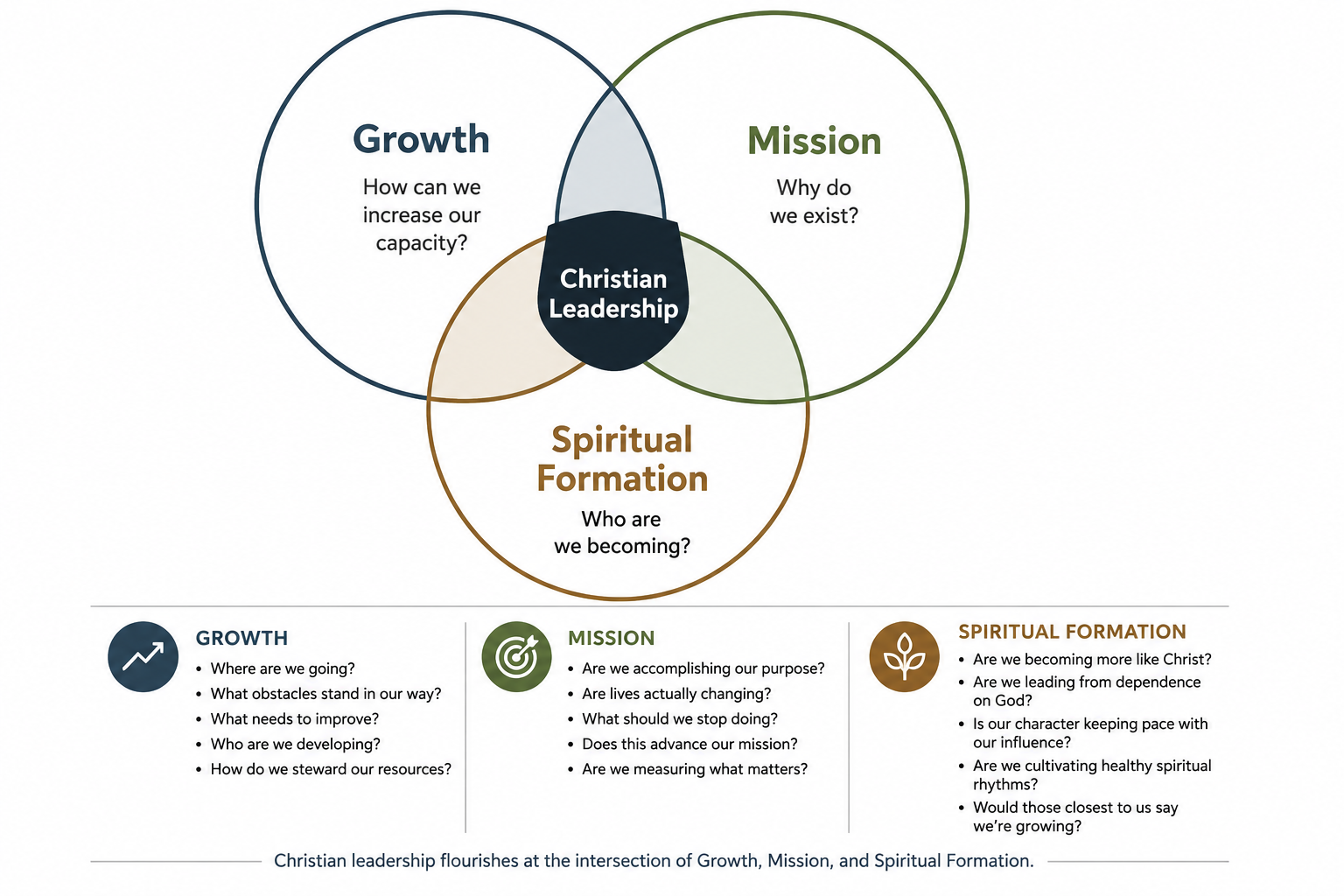
This framework has become one of the simplest ways I know to evaluate leaders and organizations.
Whenever I coach executives, pastors, or nonprofit leaders, I eventually ask: Which circle comes most naturally to you?
Almost everyone has a default.
Some are builders. They instinctively think about strategy, systems, and growth.
Others are missionaries. They constantly ask whether their work is advancing the mission.
Still others are shepherds. Their first concern is the spiritual health and character of the people they lead.
Those instincts are strengths, but they become weaknesses when they stand alone.
Growth without mission becomes ambition.
Mission without growth eventually limits impact.
Growth without spiritual formation often produces pride.
Mission without spiritual formation eventually produces burnout.
Spiritual formation without mission can become isolation.
Spiritual formation without growth settles for maintenance instead of faithful stewardship.
Faithful Christian leadership isn't about choosing one of these dimensions over the others.
It's about living in the intersection.
Let’s explore each dimension in turn and why Christian leaders who hope to build organizations that are both effective and faithful need all three.
Growth — Expanding Our Capacity to Serve
For some Christian leaders, talking about growth immediately raises suspicion.
We've all seen organizations obsessed with bigger budgets, larger buildings, higher attendance, or greater influence. We've watched leaders sacrifice their families, compromise their integrity, or manipulate people in pursuit of growth. It's understandable that many Christians instinctively recoil whenever leadership conversations turn toward expansion.
But growth isn’t the problem.
The problem is growth detached from mission and spiritual formation.
Growth itself is deeply biblical.
The opening chapters of Genesis reveal a God who creates a world designed to flourish. Adam and Eve are commissioned to "be fruitful and multiply," to cultivate creation, extend its goodness, and exercise wise stewardship over what God has entrusted to them. From the very beginning, God expects what He creates to develop, mature, and increase.
Jesus illustrates this in the Parable of the Talents.
The servants are entrusted with different amounts of resources, but each receives the same expectation: faithfully steward what has been given. The servant who buries his talent isn't condemned for producing too little. He's condemned because he refused to develop what had been entrusted to him.
Growth is stewardship made visible.
A tomato plant illustrates this beautifully.
Every tomato plant grows naturally because life has been built into it by its Creator. During its early weeks, very little intervention is required. But eventually the plant reaches a point where growth itself creates new problems. The branches become heavier. Fruit begins to weigh them down. Left unsupported, the plant sprawls across the ground, disease spreads more easily, fruit is damaged, and production declines.
Experienced gardeners don't solve that problem by wishing the plant would stop growing.
They build a lattice to support the ongoing growth.
Strategy functions in much of the same way.
Healthy strategy doesn't manufacture growth. It protects the growth God has already given.
I've seen this play out repeatedly in organizations. Several years ago I worked with a church that had grown from roughly 200 people to more than 1,000 in only five years. Everyone assumed their greatest challenge was managing success. It wasn't.
The preaching was strong. The mission was clear. People were coming to faith. The problem was that the organizational structure still assumed they were a church of 200. One ministry director carried nearly every major decision in her head. There was no clear leadership pipeline. Ministry requests flowed through one person, creating bottlenecks everywhere.
She wasn't the problem.
The absence of a structure was.
As we clarified decision-making, developed leaders, and built simple systems, something remarkable happened. The church didn't become less spiritual. It became more sustainable.
The Apostle Paul understood this balance remarkably well. Reading the book of Acts, it becomes obvious that Paul did not wander randomly around the Roman Empire hoping ministry opportunities would appear. He intentionally planted churches in influential cities. He revisited congregations to strengthen them. He appointed elders, developed younger leaders, organized financial support for struggling churches, and strategically deployed trusted teammates where they were most needed.
His ministry was completely dependent upon the Holy Spirit. It was also unmistakably strategic. Faith and planning were never competitors. They were partners.
This is one of the great gifts business leaders offer the rest of us. Healthy businesses constantly ask stewardship questions.
Where are we going?
What obstacles stand in our way?
What systems need strengthening?
How are we developing future leaders?
My point is that those are not merely business questions. They are Christian leadership questions.
The challenge, of course, is that growth by itself is never enough. Cancer grows. Debt grows. Pride grows. Growth is only good when it serves something greater than itself.
That's why the second circle matters just as much as the first.
Mission — Remembering Why We Exist
If growth asks, "How can we increase our capacity?", mission asks a different question:
"Why do we exist?"
This is the question that keeps organizations from drifting.
Every organization begins with a clear sense of purpose. A business exists to solve a problem, a nonprofit addresses a need, and a church makes disciples and proclaims the gospel.
Every organization begins with a clear mission. Over time, however, that mission can become buried beneath layers of activity. New programs are launched. New ministries are created. New initiatives are added. Rarely does anyone ask what should end. As the organization grows more complex, leaders can become consumed with managing what exists instead of pursuing why it exists.
Mission drift rarely happens because leaders stop caring.
It happens because busyness obscures the mission.
That's why every leader needs to regularly ask uncomfortable questions.
What are we doing that no longer advances our mission?
If we were starting today, would we create this program?
Are we measuring activity or impact?
Where are we investing time, money, and attention simply because we've always done it?
These are difficult questions because every "yes" to one opportunity is a "no" to another.
Leadership is not primarily about adding. It is about choosing.
Jesus modeled this throughout His ministry.
Crowds constantly demanded His attention. There were always more people to heal, more villages to visit, more needs to meet. Yet Jesus repeatedly refused to be controlled by the expectations around Him.
After healing many in Capernaum, the disciples urged Him to stay because more people were looking for Him.
Instead Jesus said,
"Let us go somewhere else—to the nearby villages—so I can preach there also. That is why I have come." (Mark 1:38)
Jesus wasn't indifferent to people's needs.
He was governed by His mission.
The same clarity marked the early church.
When conflict arose over the daily distribution of food, the apostles didn't conclude that every important need should become their responsibility. Instead, they appointed qualified leaders to oversee that ministry so they could remain devoted to prayer and the ministry of the Word (Acts 6).
Mission clarity gives leaders permission to say no. Not because opportunities are bad, but because not every good opportunity is your opportunity.
Peter Drucker famously said, "There is nothing so useless as doing efficiently that which should not be done at all."
Christian leaders should feel the weight of that observation.
It is possible to become extraordinarily effective at accomplishing things God never asked us to do.
That is why mission must continually shape growth.
Growth without mission simply gives us greater capacity to become distracted.
Mission tells us where to invest that capacity by keeping us focused on why we exist.
And yet even a crystal-clear mission is not enough.
History is filled with leaders who accomplished remarkable things while neglecting the condition of their own souls.
Which leads to the third dimension of Christian leadership.
Not simply what we accomplish.
But who we are becoming.
Spiritual Formation — Becoming the Kind of Leader God Wants
Growth asks, "How can we increase our capacity?"
Mission asks, "Why do we exist?"
Spiritual formation asks a far more personal question:
"Who am I becoming?"
This may be the most important question of all.
Leadership has a way of revealing what was already in our hearts.
Success can amplify pride.
Pressure can expose impatience.
Criticism can uncover insecurity.
Many leaders assume that if they become more successful, they'll naturally become wiser, humbler, and more Christlike.
The opposite is often true.
Leadership doesn't automatically produce maturity. Sometimes it reveals where maturity has not yet taken root.
That's why Scripture consistently places greater emphasis on the character of the leader than the competency of the leader.
When Paul lists the qualifications for elders in 1 Timothy 3 and Titus 1, he spends remarkably little time discussing leadership skills. Instead, he focuses on integrity, self-control, faithfulness, humility, and the way a leader lives at home.
God seems far more interested in who a leader is than what a leader can accomplish.
That doesn't mean competency doesn't matter. But it does mean competency without character is dangerous.
History is filled with gifted leaders who built extraordinary organizations while quietly neglecting their own souls. Eventually, those cracks always become impossible to hide.
It is a precocious when influence exceeds formation.
Dallas Willard once wrote, "The most important thing in your life is not what you do; it's who you become."
Christian leaders should never forget that.
Our first calling is not to build impressive organizations, but to become people who increasingly resemble Jesus.
That transformation doesn't happen accidentally. It happens through ordinary, faithful practices.
Time in Scripture.
Prayer.
Confession.
Sabbath.
Worship.
Christian community.
Repentance.
These practices don't simply prepare us to lead. They are the means by which God forms us into the kind of people who can be trusted with leadership.
One of the most searching questions a leader can ask is this:
Is my character keeping pace with my influence?
As our opportunities expand, our dependence upon God must expand even more.
That's why spiritual formation isn't another item on the leadership checklist.
It is the foundation beneath everything else.
Growth without spiritual formation produces ambitious leaders.
Mission without spiritual formation produces exhausted leaders.
But when growth, mission, and spiritual formation are held together, something beautiful happens.
Leaders become faithful stewards. Organizations remain focused on God's purposes. People flourish. And Christ is honored.
That is Christian leadership.
Conclusion: The Leadership the World Needs
Most leadership books answer one question.
How do you build a better organization?
That's an important question. But for the Christian leader, it shouldn’t be the only question. Our calling is not simply to build successful organizations. Our calling is to faithfully steward whatever God has entrusted to us.
Sometimes that stewardship will require expanding our capacity.
Sometimes it will require returning to our mission.
Sometimes it will require slowing down long enough for God to reshape the leader before He expands the work.
The wisdom is knowing which question needs to be asked today.
That's why I don't think of Growth, Mission, and Spiritual Formation as three separate priorities. I think of them as three lenses and every important decision should be viewed through all three. The next strategic plan, budget, hire, new initiative, or opportunity- i magine what would happen if Christian leaders consistently asked:
Will this increase our capacity to serve?
Will this advance the mission God has given us?
Will this help us become more like Christ?
Those answers won't always be easy. Sometimes they will force us to slow down when we'd rather move faster, or compel us to say no to good opportunities, or even expose weaknesses in our own hearts.
But that's exactly the point.
Christian leadership is not merely about making better decisions. It's about becoming the kind of leaders who are capable of making them.
The church doesn't simply need more visionary leaders. Or more strategic leaders. Or even more spiritually minded leaders. It needs leaders whose capacity is shaped by their mission and whose mission is sustained by a life deeply rooted in Christ.
That is the kind of leadership our organizations need.
More importantly, it's the kind of leadership the world needs to see.
